Websites for a maritime training network: Sea Scan Maritime Foundation and Sea Scan Group
Regulated courses, two admission routes, two training centres and students browsing on their phones — how we structured websites for Sea Scan's maritime institutes in Goa.
 Project story
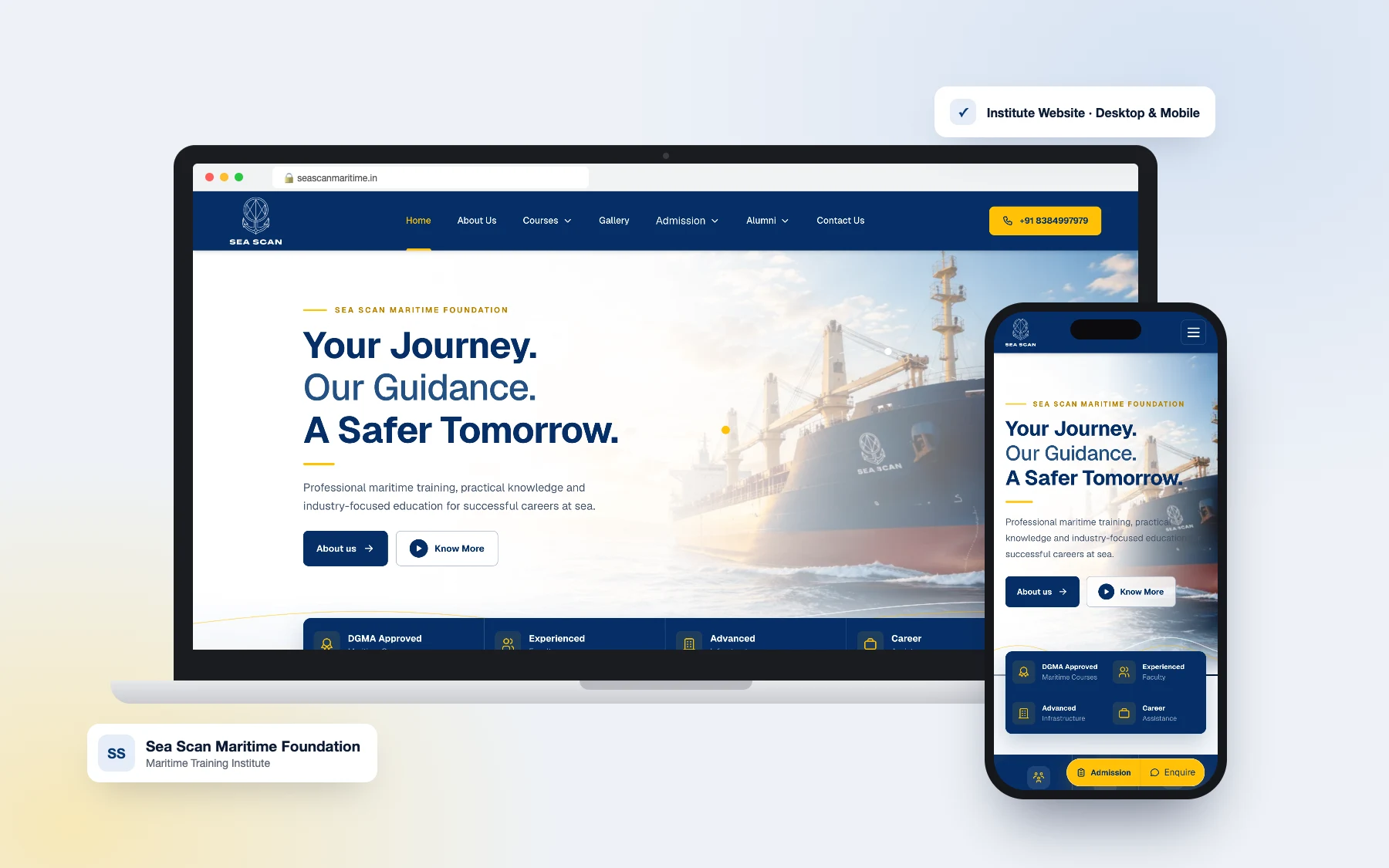
Sea Scan Maritime Foundation is a DGMA-approved maritime training institute in Verna, Goa, with an office in Mumbai. Its sister institute, Seascan Marine Foundation, trains seafarers in Chicalim. We designed and built websites for both the institute and the wider Sea Scan Group. Here is how we approached a subject where the courses are regulated, the routes into them differ, and most visitors are students and parents on a phone.
Making regulated courses easy to compare
Maritime training has its own vocabulary: GP Rating, CCMC, BST, STSDSD, PSF and refresher courses. Each one now has its own page with its duration and admission details, so a student can find the right programme without decoding a long combined list.
Two admission journeys, not one confusing form
Pre-sea courses and STCW courses have different admission routes, so the website gives each its own journey. On mobile, sticky Admission and Enquire actions stay within reach while students read, which matters when the decision is made on a phone.
An alumni registration and login area, a training gallery and Google reviews help prospective students move from discovery to enquiry with confidence. Analytics are consent-based, with a cookie settings panel.
One front door for the group
Sea Scan Group brings the Verna and Chicalim institutes together. The challenge was giving two related institutes one clear entry point without duplicating their own websites. The group site introduces each centre with its location and speciality, and a shared course finder shows which programmes run at which centre — linking straight through to the right centre's course and admission pages.
The technology
The institute website is built with Next.js, Tailwind CSS and Mantine for a fast, mobile-first experience. The group website is a responsive React and Tailwind CSS build.
What other training institutes can learn
Give every course its own page, separate admission routes that really are different, and keep the enquiry button visible on mobile. If you run several centres, route each course to the centre that actually delivers it instead of copying content across sites.
Free consultation
Want a clear, itemised quote for your project?
Tell us what you need — we usually reply within one business day.